Some links are affiliate links. The site may earn a commission from qualifying purchases at no extra cost to you.
The best floor jack for your garage is the one that fits your vehicle’s approved lifting arrangement, working height and capacity requirements. Start with measurements and the exact equipment manual, then compare handling, service support and cost. No model is the best choice for every vehicle.
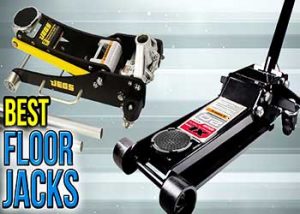
This guide brings together floor-jack types, model documentation and buying checks. The model notes are research-based comparisons, not a new hands-on test or a guarantee of current price, availability or reliability. Where a model revision or specification remains uncertain, it is identified below.
New to vehicle lifting? Read the capacity and fit guide, locate the approved jacking points and review the safety checklist first. A hydraulic jack raises the vehicle; suitable stands provide the support required before working underneath.
Different types of vehicle jacks
Hydraulic floor jacks
A wheeled hydraulic floor jack uses a pumping handle and hydraulic mechanism to raise its saddle. The chassis, wheels, saddle and handle all need room to operate in the approved lifting arrangement. Check the manual rather than treating all hydraulic controls, oil specifications or maintenance routines as identical. Compare our hydraulic floor-jack guide.
Mechanical scissor jacks

A scissor jack uses a screw-driven mechanism and is often associated with the specific emergency procedure described by a vehicle manufacturer. That does not make every scissor jack a universal replacement or a workshop support tool. Match its rating and contact point to the vehicle instructions. See scissor-jack safety and use.
Bottle jacks

A bottle jack has a more upright hydraulic layout. Its starting height, saddle contact and operating orientation matter when judging vehicle fit. Capacity varies by model; a bottle shape alone does not imply a 50-ton rating or suitability for every tall vehicle. Read the bottle-jack buying guide for the separate selection considerations.
Floor-jack comparison chart
The chart retains five models from this guide. Read the notes beneath it before using a figure: documentation revisions and adapter configurations matter. A missing verified specification is left explicit instead of being filled with a guess. Offer links may show a different revision or current availability.
On a small screen, scroll the comparison table sideways to read all columns. Keyboard users can focus the table region and use the arrow keys.
 |  |  | 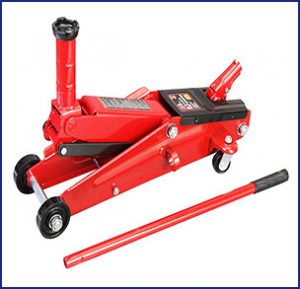 | 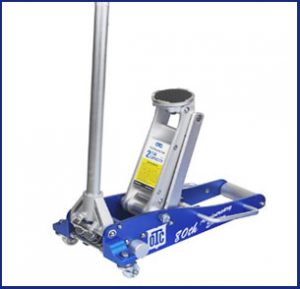 |
|---|---|---|---|---|
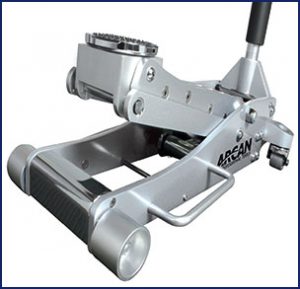
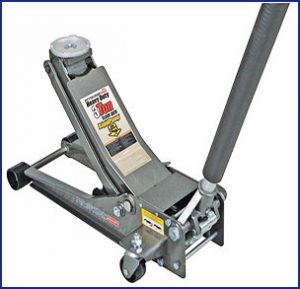
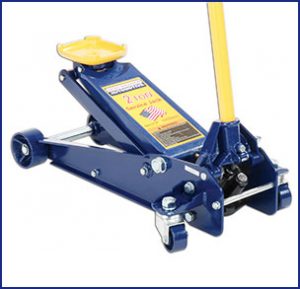
| Arcan ALJ3T Aluminum Floor Jack | Pittsburgh Automotive 3 Ton Low Profile Floor Jack | Hein-Werner HW93642 Blue Hydraulic Service Jack | Torin T83006 SUV Service Jack | OTC 1532 2-Ton Capacity Aluminum Racing Jack |
| Price: check current offer | Price: check current offer | Price: check current offer | Price: check current offer | Price: check current offer |
| Capacity: 3 ton (match revision) | Capacity: verify exact 3-ton item | Capacity: 2 ton | Capacity: 3 ton without adapter; 2.5 ton with SUV adapter (20161111 manual) | Capacity: 2 ton (1532) |
| Tool weight: not confirmed; manual lists shipping weight | Tool weight: verify exact item | Weight: 99 lb (manufacturer catalog) | Tool weight: verify exact revision | Tool weight: 43 lb (OTC documentation) |
| Construction: aluminum service jack | Construction: verify exact item, not a mixed-model description | Construction: cast-iron lift arm and pump; not an all-cast-iron body claim | Construction: verify exact model documentation | Construction: aluminum (1532) |
| Check Price: Arcan ALJ3T | Check Price: Pittsburgh low-profile jack | Check Price: Hein-Werner HW93642 | Check Price: Torin T83006 | Check Price: OTC 1532 |
Model features, evidence and limitations
1. Arcan ALJ3T aluminum floor jack
The ALJ3T is a 3-ton aluminum service-jack model with several older specifications circulating online. The 2013 manual reviewed here identifies its own working range and labels its weight figure as shipping weight. Do not copy that figure into a tool-weight comparison or mix it with a different Arcan revision.
Compare the ALJ3T documentation review with the exact model offered. Check access and stand height before deciding that an aluminum or low-profile description fits the job. No promise of trouble-free use is made.
2. Pittsburgh 3-ton low-profile floor jack
The older description mixed steel and aluminum models and claimed a two-foot lift without identifying the item number. Those statements are not a reliable specification for the jack pictured. Pittsburgh has sold different items under similar descriptions; identify the exact item on the label before comparing.
For example, the official item 56617 manual lists a 3-ton rating and a 3-1/8-to-19-7/8-inch saddle range. That example is not confirmation that the older offer or image is item 56617. A fast-approach pump claim also should not be turned into a guaranteed loaded lift in a fixed number of strokes.
If the seller cannot identify the item and supply its manual, pause the comparison. For clearance questions, start with the low-profile floor-jack guide.
3. Hein-Werner HW93642 service jack
The manufacturer service-jack listing identifies the HW93642 as a 2-ton model. The range’s cast-iron pump and lift-arm construction should not be reduced to a claim that the whole jack body is cast iron.
The manufacturer catalog lists a 4.5-to-20-inch range and 99-pound weight for HW93642. Confirm the supplied revision and handling arrangements before purchase. A heavy jack can be inconvenient to carry even when it rolls well on a suitable workshop floor; weight alone is not proof of quality.
4. Torin T83006 SUV trolley jack
The T83006 manual, version 20161111 distinguishes two configurations: 3 tons without the adapter, with a 5-7/8-to-17-1/4-inch range; and 2.5 tons with the SUV adapter, with a 9-1/4-to-20-7/8-inch range. The capacity reduction must not be omitted when discussing the extra height.
Use only the specified configuration and confirm that the manual matches the actual unit. The word “SUV” does not establish fit, and an extension is not permission to improvise additional height.
5. OTC 1532 aluminum racing jack
OTC’s 1533 pack documentation identifies the included 1532 jack as a 2-ton aluminum model weighing 43 pounds, with a 3-1/2-inch minimum and 18-inch maximum height. Pack shipping dimensions and weight are not the jack’s own measurements.
OTC also has later model numbers, so do not substitute 1532A specifications for 1532 without checking. This is a vehicle service jack, not a transmission jack. A removable saddle pad does not guarantee that every lifting point is suitable or eliminate the need for correct support.
Budget listings: check today’s offer, not an old price label
This section previously used an “under $100” headline. That price ceiling and the old blanket recommendations have not been verified for current offers. The following entries remain for readers identifying older products; they are not a live price ranking. Compare the complete cost, documented fit, condition, return terms and service support.
1.5-ton compact aluminum racing jack

The earlier listing did not establish a precise current item revision. Ask for the model label and manual before relying on its capacity, height or pump-count wording. Compact storage does not establish suitability for a truck, and light weight does not remove the need for a safe lifting arrangement.
Pro-Lift F-767 low-profile floor jack

Verify F-767 on the label and obtain its own manual rather than borrowing instructions from the F-2533 or another Pro-Lift model. Low entry height and sufficient working travel are separate checks. A jack that loses pressure needs assessment; it is not simply a harmless disadvantage to accept.
Torin T82002-BR hydraulic trolley jack

Match the complete model suffix and current manual. Check reach, operating range and approved handle movement rather than assuming the jack can be operated at any angle. The former “zero problems” claim was not evidence of reliability and is no longer used.
Torin T83002 floor jack

Check the exact revision and working range before using an older offer as a comparison. A three-ton label does not prove that every truck can be lifted to the support height needed for a particular repair. No product can be promised to remain free of defects or operating problems.
Torin T82751 floor jack

Confirm the capacity, lift range, product weight and service information from the supplied documentation. Do not infer suitability for large tires or strut work from a historic review. The job, approved lifting points and required support arrangement determine whether the equipment fits.
If an offer lacks traceable documentation, compare a model with a matching manual instead. Our Pro-Lift F-2533, Blackhawk B6350 and Arcan ALJ3T reviews identify their evidence and limits. The Liftmaster and Powerzone 380044 pages explain unresolved model/support questions.
What to measure before buying a floor jack
Rated capacity and the lifting arrangement

Follow the vehicle and equipment instructions. Do not assume that the front of every vehicle carries 60 percent of its weight or that a fixed fraction automatically determines a safe jack capacity. Check the rating for the exact configuration, including any approved adapter. Use the capacity guide to organize the decision.
Material, weight and handling
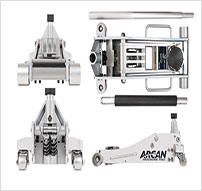
Steel, aluminum and hybrid construction involve different designs, not a universal quality ranking. Compare actual tool weight, carrying points, serviceability and the conditions in which the jack will be moved. Neither material guarantees corrosion resistance, long life or safe use on an unsuitable surface.
Clearance, reach and maximum height

Check the whole path to the approved lifting point, the saddle contact and room for the handle. Then check the height needed for the support arrangement. There is no universal rule that a jack exceeding 20 inches is unsafe; suitability depends on its rated design and intended use. Never improvise extra height to compensate for the wrong equipment.
Lift speed and controls

A fast unloaded approach is different from lifting a vehicle under load. Compare how the manufacturer defines a pump-count claim and how controlled lowering works. Speed is secondary to the ability to position and operate the equipment correctly.
Price, warranty and parts
Ask for current terms from the actual seller. Keep tool-only and package comparisons separate, and budget for appropriate support equipment. Price or appearance alone does not establish safety or value. For a broader selection workflow, read how to choose a floor jack and the vehicle-fit worksheet.
Supporting equipment and separate lifting jobs
Jack stands

Select stands for the load, support points, saddle contact and working height. Read whether the stated capacity applies to a stand or a pair; do not assume one convention covers every product. Start with how to choose jack stands and the stand comparison guide.
Wheel chocks
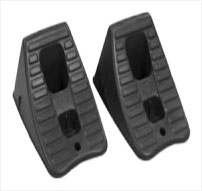
Plan the wheel restraints specified by the vehicle and equipment instructions. A parking brake does not replace every other required precaution. Check the tire contact and working surface, rather than choosing chocks solely because they are inexpensive.
Vehicle ramps
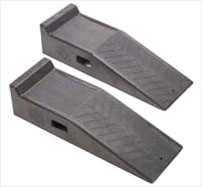
Drive-on ramps have a different intended use from a jack-and-stand setup and normally leave the wheels supported on the ramps. Check the task, rating, tire fit, approach and restraints in the ramp instructions. See the car-ramp guide before deciding whether they suit the work.
Mechanics creepers
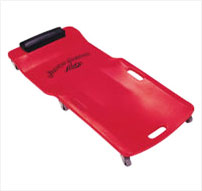
A creeper helps with movement and comfort; it does not support a vehicle. Confirm secure vehicle support and adequate working clearance before going underneath. Keep the oil-change tool checklist separate from the lifting and support plan.
Transmission and motorcycle lifting

These jobs need equipment designed for the load and contact arrangement. Do not assume a generic adapter converts any floor jack into a transmission jack, or that an automotive saddle fits a motorcycle. Use manufacturer-approved equipment and instructions; compare the separate motorcycle-jack guide where appropriate.
Care and inspection after purchase
Keep the model manual and inspect before use. Follow its cleaning, lubrication, fluid-service and storage instructions. A weak lift is not proof that oil or air is the only problem, and a damaged jack should not be kept in service by repeated topping up.
Use the maintenance workflow, ten-point inspection checklist and manual-first bleeding guide for their distinct purposes. Persistent faults need the repair-or-replace decision, not an improvised safety-valve adjustment.
Final buying decision
Choose the model whose documented limits fit your actual job and whose condition and support can be verified. If a key point remains unresolved, delay the lift or purchase. A customer rating, affiliate offer or “best” label should not override the vehicle and equipment instructions.